Issue No. 2: The Fifty Fathoms
It is not difficult to imagine the Fifty Fathoms as an instrument that remained unseen. It was designed to measure time where time could not be guessed. It endured because that requirement did not change.
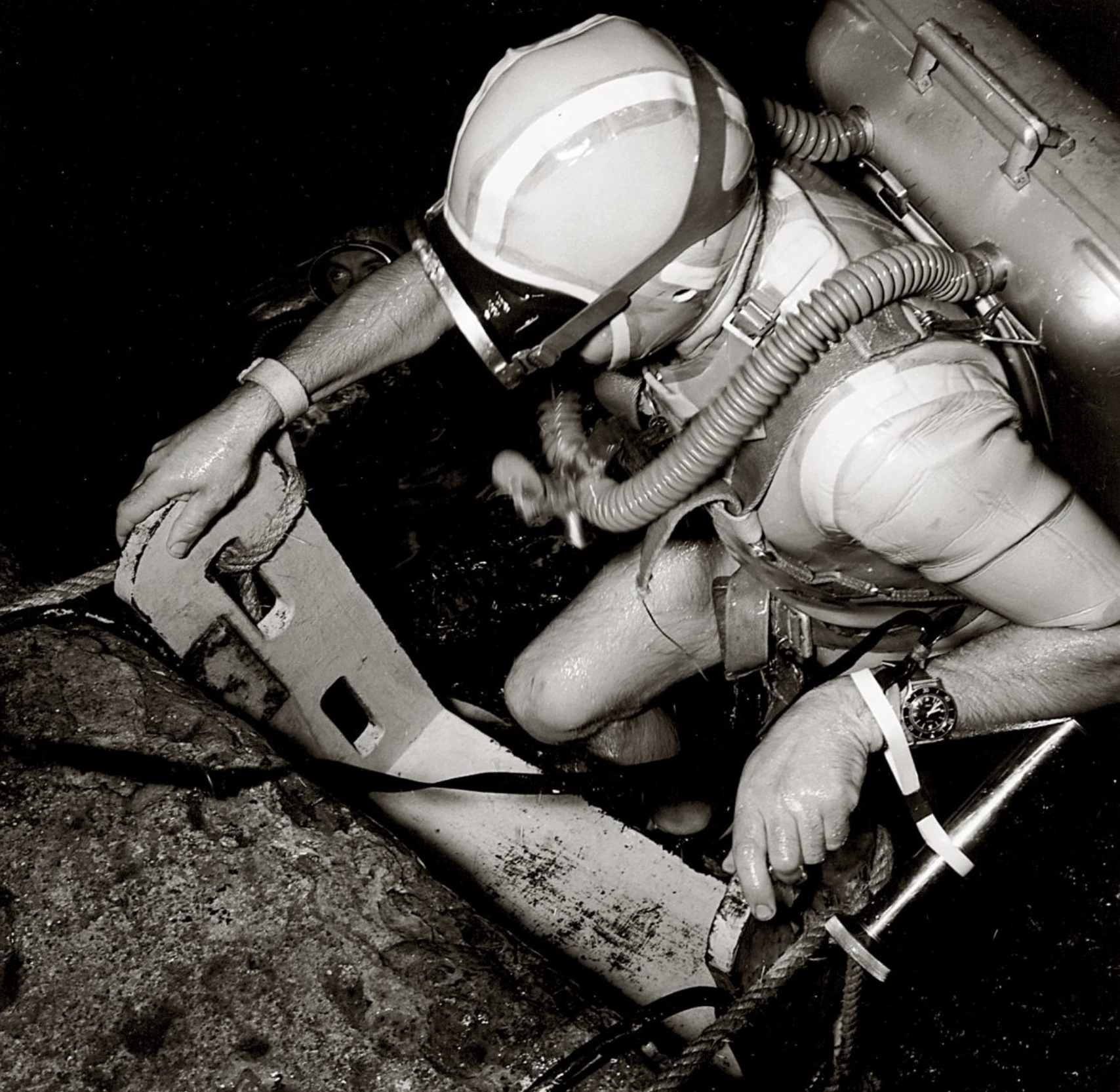
Mediterranean coast, early 1950s.
The cold arrives first.
It spreads through the water in layers, touching the hands before the face, then tightening across the chest as depth increases. The surface light fades slowly from blue to green. Sound narrows until only the quiet rhythm of breathing remains.
Air moves through the regulator in steady pulses. Each exhale rises in a chain of silver bubbles drifting toward the surface he has just left behind.
Jean-Jacques Fiechter feels the resistance in his breathing before he fully understands it.
He checks the gauge. He kicks upward without ceremony, abandoning the careful measured ascent the procedure manuals describe. The surface comes up fast and bright and he breaks through it gasping, the regulator still clamped in his teeth.
He floats there for a moment and lets his breathing settle.
When the adrenaline fades, one thought remains.
That cannot happen again.
At the time, Fiechter is not simply a diver. He is the chief executive of Blancpain, having joined two years earlier at the invitation of his aunt, Betty Fiechter, who had run the company since the 1930s. He arrived young, inheriting both an institution and a responsibility. The family had kept Blancpain alive through Depression and war. Now the ocean had reminded him that inheritance is not the same as control.
The problem was not the watch itself. Several manufacturers had already achieved waterproofing.
But waterproofing was not the same as designing a watch for the ocean.
What Fiechter needed—and what had failed him in the water—was the ability to know, with certainty and at a glance, in cold and murky water with his pulse still elevated, exactly how long he had been below.
Time determines ascent. Time determines decompression. Time determines whether a diver returns to the surface.
He had guessed. He had nearly paid for it.
Guessing was unacceptable.
For centuries, the sea had been a surface world. Sailors crossed it, but very few people worked within it. Depth belonged to anchors and fishing nets, to myth and imagination.
That began to change in the years after the Second World War.
In 1943, Jacques-Yves Cousteau and engineer Émile Gagnan developed a breathing apparatus they called the Aqua-Lung. The device allowed divers to move underwater freely, breathing compressed air through a regulator that adjusted automatically to depth.
For the first time, a person could descend, swim, and work beneath the surface without being tethered to the ship above.
The sea opened.
Scientists explored reefs and wrecks. Filmmakers descended with cameras. Naval units began forming teams of combat swimmers capable of approaching ships and harbors silently from below.
The early Cold War gave these experiments urgency.
Harbors and shipping lanes had become strategic terrain. Nations needed divers who could move unseen beneath the surface and return with reliable information. Those divers required equipment that could function in darkness, pressure, and cold water.
The technology of diving was improving quickly.
The watch remained an afterthought.
Robert Maloubier had been many things before he became a diver.
In June of 1940, he was seventeen years old, pedaling a bicycle four hundred miles south toward Bordeaux along roads choked with refugees, German Stukas working the column overhead. He was trying to reach England. He didn't make it—not yet. He spent two more years in France, crossing the demarcation line between occupied and free territory, getting caught, serving prison time, getting out.
By 1942 he was in North Africa. By early 1943 he was in England, training as a saboteur for Churchill's Special Operations Executive. That summer they parachuted him back into Normandy behind the Atlantic Wall. His unit blew up a power station, a steel plant, and a submarine tender. The Germans caught him. He was shot twice. He escaped and was flown back to England on a clandestine RAF mission that landed by moonlight.
He returned to France the day after D-Day. Then the Far East. Then back to France again.
By 1952, Maloubier was a captain stationed at Oran on Algeria's Mediterranean coast. The war had given him a particular kind of education. He understood, at a cellular level, that men died when their equipment failed them.
Now he was responsible for standing up something new: the École des Nageurs de Combat, the French Navy's combat swimmer school. The unit's missions involved moving silently underwater at night, gathering intelligence, placing explosives on enemy ships. The lives of his men would depend entirely on their gear.
He and his colleague Lieutenant Claude Riffaud traveled to Paris to find a watch.
The results were disastrous.
Maloubier examined the watches with the same standard he had once applied to detonators and radios behind enemy lines: if a piece of equipment could fail, eventually it would.
The watches available were too small, difficult to read in low visibility, and nowhere near waterproof enough for serious diving. A man who had survived three gunshot wounds and two parachute insertions into occupied France was not going to send his swimmers underwater with a dress watch.
He needed an instrument.
Something built for the sea.
Maloubier began looking for someone who could build one.
The idea revealed itself in a small movement of the hand.
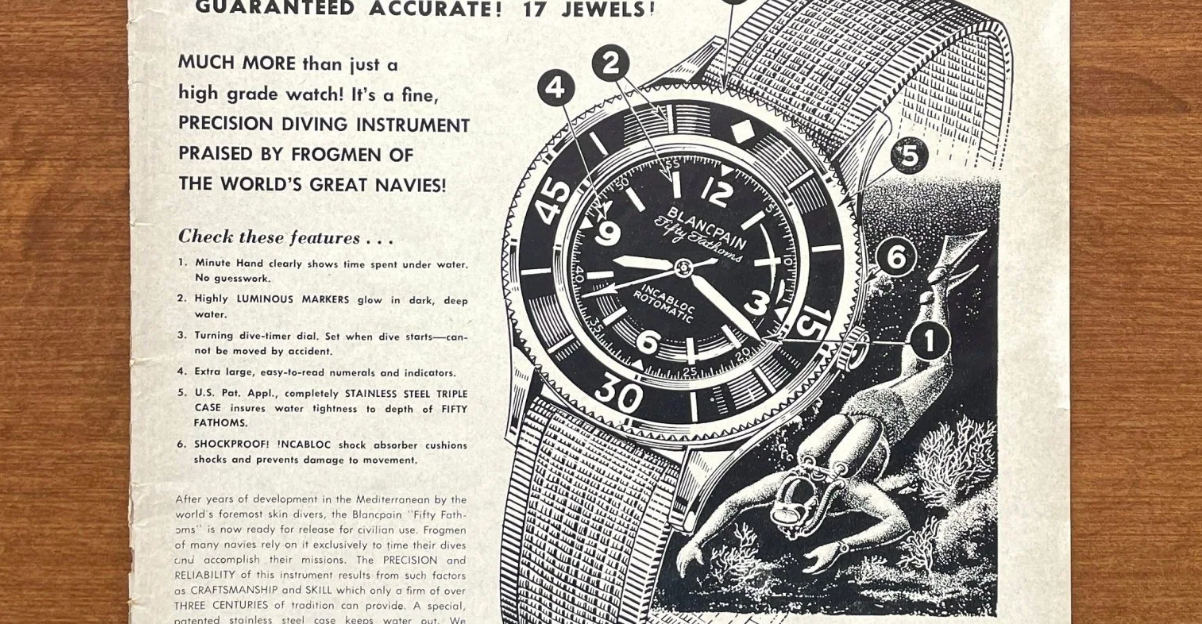
Before entering the water, a diver grips the edge of his watch and turns the ring that surrounds the dial. The luminous marker at the top of the bezel aligns with the minute hand. From that moment forward, the watch no longer measures the hour. It measures the dive.
Each passing minute moves the hand away from the marker.
No arithmetic. No guesswork.
The watch remembers.
The bezel moves in only one direction. If it is knocked during the dive, the error shortens the perceived time underwater rather than extends it. The design errs deliberately on the side of caution.
For Maloubier and his combat swimmers, the value was immediate. Thick gloves, low visibility, and the pressure of time beneath the surface left little room for interpretation. A man who had once operated in enemy territory with nothing but instinct and a radio now needed the same clarity from a watch that he once needed from a detonator—it had to work, every time, without question.
The watch had to think for the diver.
From these requirements a new instrument began to take shape inside Blancpain.
It would eventually receive a name.
The name came from depth.
Early scuba equipment imposed limits that divers understood well. Beyond a certain point the pressure, gas mixtures, and risk of decompression made further descent increasingly dangerous.
Fifty fathoms.
Roughly ninety meters of water.
The name was not poetic. It was descriptive. The watch carried the measure of the boundary itself—a number that every serious diver already knew and respected.
The instrument that emerged from those constraints would be known as the Blancpain Fifty Fathoms.
Fiechter would later say that the design process involved less invention than elimination. Each feature that remained on the watch had survived a simple question: would it still matter underwater? Anything ornamental disappeared quickly. What remained was legibility, resistance, and the ability to measure time without hesitation.
The watch was not meant to impress anyone above the surface.
It was meant to behave predictably below it.
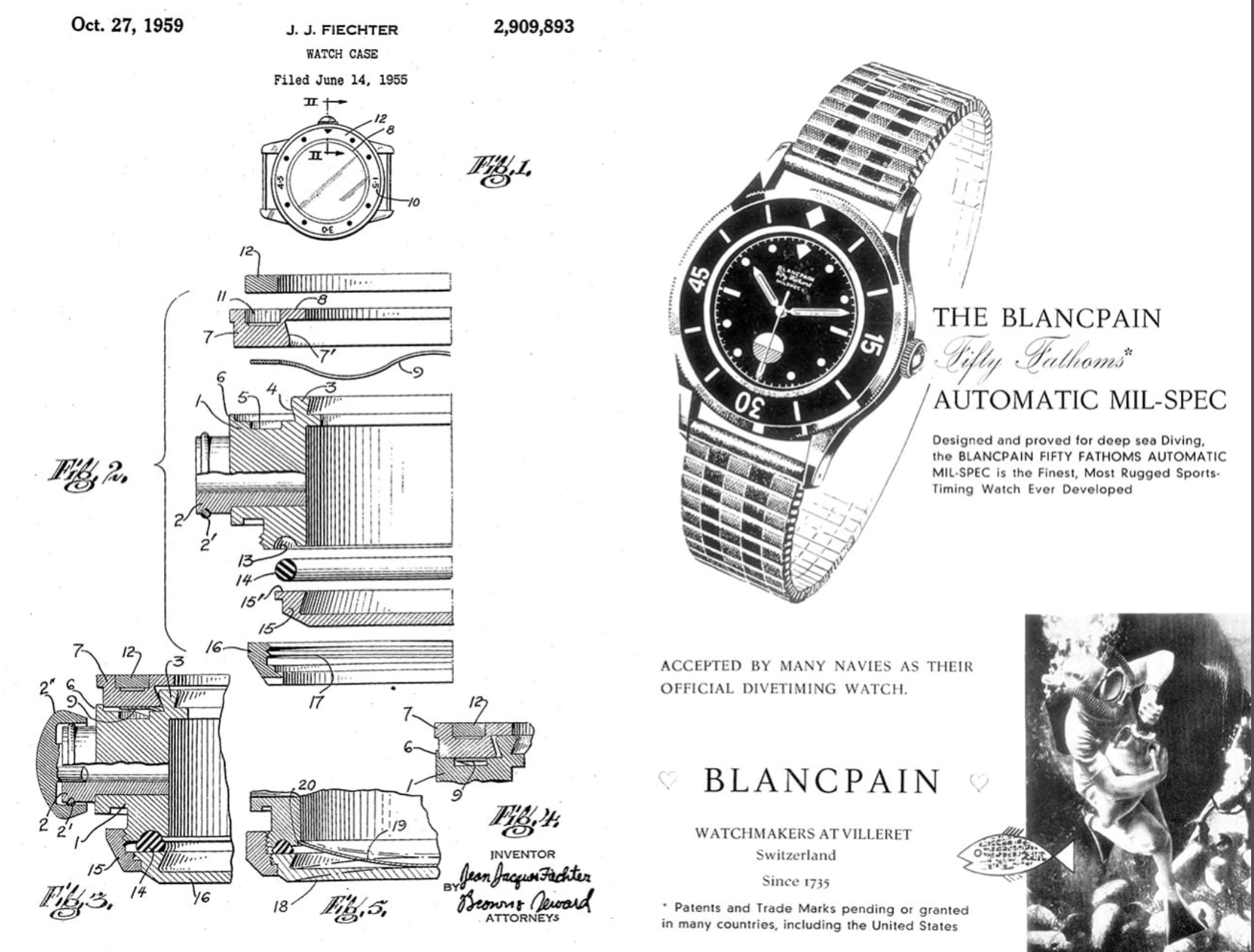
Decades later, the gesture remains the same.
A diver preparing to enter the water pauses and turns the bezel. The luminous marker aligns with the minute hand. The beginning of the dive is fixed.
From that moment forward, the watch remembers.
The diver does not need to calculate anything. Each passing minute moves the hand away from the marker. A glance is enough.
The ritual is simple, almost mechanical. But inside that motion lives a long chain of decisions: a young executive surfacing too quickly off the Mediterranean coast; a decorated soldier testing inadequate watches in a Paris shop and finding them wanting; a small Swiss manufacture choosing to build an instrument rather than another wristwatch.
Beneath the surface, the light fades. The minutes begin their quiet work.
At fifty fathoms, the watch remembers.