Issue No. 1: The Royal Oak
It is not difficult to imagine AP's Royal Oak as a footnote. In 1972, it was oversized, expensive, and uncertain. It survived because conviction held longer than doubt.
Winter, 1971. Le Brassus.
The Vallée de Joux is quiet in a way cities never are. Snow absorbs sound. Workshops glow behind stone walls. For generations, watchmakers here have built complications so precise they feel devotional.
Inside one of those workshops, the leadership of Audemars Piguet confronts a shift they can no longer ignore. The world is accelerating.
In 1969, Seiko introduced the Astron, the first commercially available quartz wristwatch. It did not rely on springs or escapements. It pulsed electronically and kept time with a precision that mechanical watches could not match. At first, it seemed novel. Then, it began to scale. Factories replaced benches. Circuits replaced regulation. Production that once required apprenticeship now required assembly. For the first time in centuries, the Swiss did not own accuracy. They owned tradition.
Quartz did not kill mechanical watchmaking. It displaced its central claim. Accuracy was no longer persuasive. Precision could be mass-produced. What remained was something less measurable: identity. In that vacuum, design stopped being ornament and became strategy.
Before 1972, Audemars Piguet was known for restraint. Thin gold dress watches. Extra-flat calibers. Perpetual calendars in precious metal cases. Complications executed with seriousness and discretion. Most measured between thirty-three and thirty-five millimeters. A thirty-six millimeter chronograph already carried presence.
The formula had endured for decades, but it was built for a world that was fading. AP produced only a few thousand watches per year. It did not compete on volume; it competed on craft. That left little margin for error. When demand softened, the effect was immediate. Younger buyers were less formal. Gold felt ceremonial. Precision, once mechanical watchmaking’s proudest claim, now belonged to quartz. Orders slowed. Retailers hesitated. Stability began to resemble stagnation.
Georges Golay saw the asymmetry. A farmer’s son from the Vallée, educated in commerce at the University of St. Gallen, he had joined Audemars Piguet as an accountant in 1945 and risen to managing director twenty-one years later. He was not part of the founding families, but he had become one of the house’s most trusted stewards. A man who understood the numbers well enough to know when they no longer told a reassuring story.
Around this time, AP’s Italian distributor, led by Carlo De Marchi in Milan, signaled something unusual. Clients were asking for a steel sports watch. Not a diver. Something refined. Something modern. Something that could be worn daily.
Golay could have dismissed it. Audemars Piguet did not make steel sports watches. Yet standing still was beginning to look riskier than movement.
He called Gérald Genta.
Years later, Genta recalled the call: the managing director telephoning late in the afternoon, with his strong Vallée accent, asking for a steel sports watch unlike anything before — and needing the design by morning.
Genta was thirty-eight years old, already moving confidently through the upper circles of Swiss watch design. Independent and quick-handed, he possessed a designer’s certainty that form could reshape perception. Those who worked with him described an elegant stubbornness; once he saw a line in his head, he rarely softened it. He once remarked, “I don’t like watches. For me, watches are the antithesis of liberty.” The comment was not flippant. Genta approached watches less as instruments than as composition: proportion, tension, silhouette. Timekeeping was assumed. Identity was deliberate.
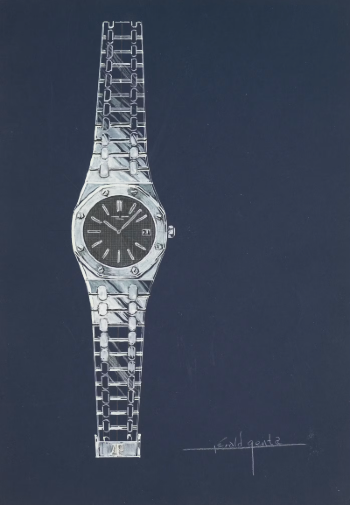
The brief was simple: a steel sports watch, finished to haute horlogerie standards, ready for Basel. In early April, with the fair approaching and the air still carrying the chill of Swiss spring, Genta sat at his drafting table and began to draw. Whether the entire design emerged in a single night has become part of the mythology. What matters is that it emerged intact: an octagonal bezel inspired by the form of a deep-sea diver’s helmet, eight exposed screws, a bracelet integrated directly into the case, as though carved from a single idea rather than assembled from parts.
When the prototype returned to Le Brassus, it did not resemble anything in the existing catalog. At thirty-nine millimeters, it did not merely grow; it redefined proportion. Compared to AP’s mid-thirty-millimeter dress watches, it felt architectural, like a modernist structure set abruptly among stone cottages. The wide, flat bezel amplified the scale. Without traditional lugs to taper the silhouette, the case seemed broader still. It did not look like refinement. It looked like interruption.
The internal objections were practical. Steel at this price? Above many gold references? Would retailers take it seriously? Would clients? The Royal Oak did not feel like a new reference. It felt like a new direction. Direction implied commitment.
Golay pressed his case. The board was not entirely convinced. Precision alone could no longer guarantee relevance. Preservation without adaptation was erosion. Pricing became its own fault line. To price below gold would concede inferiority. To price above gold would test belief. Genta did not hedge; he believed the design would reshape taste.
In the end, they chose conviction.
One thousand pieces.
Contained.
But exposed.
It was not clear that they had chosen correctly.
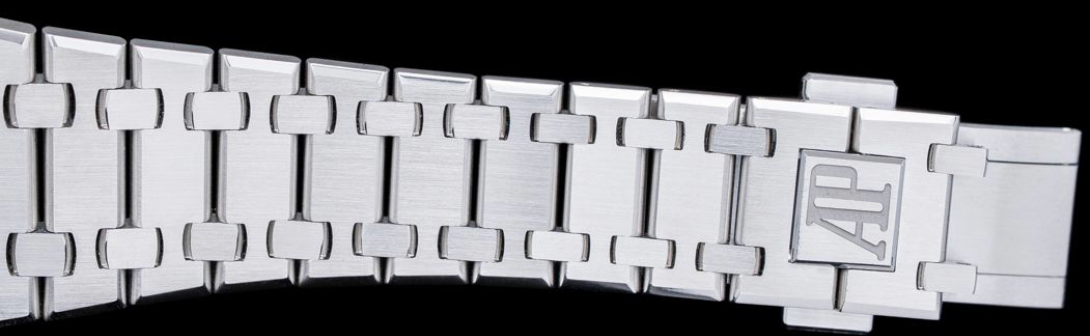
Approving the Royal Oak meant more than accepting a new silhouette. It required changing how the company built watches. Steel, contrary to intuition, was harder to finish than gold. It resisted polishing and revealed every flaw. The Royal Oak’s sharp bevels and alternating brushed-polished surfaces demanded more labor, not less. The integrated bracelet required a new discipline. Case and bracelet formed a single continuous object, each link individually finished, every transition aligned. In photographs, it appeared rigid, almost armored. On the wrist, it behaved differently, settling with a suppleness that contradicted its geometry and distributing weight evenly, like a tailored jacket whose structure you only notice when you remove it.
Inside, Audemars Piguet chose the ultra-thin caliber 2121, derived from Jaeger-LeCoultre’s 920 ébauche, one of the most refined automatic movements of its era. The heart remained traditional haute horlogerie. Steel on the outside, legitimacy within. The final production reference, 5402ST, remained remarkably faithful to Genta’s original drawing. Minor adjustments were made for tolerances and sealing, but the audacity survived the transition from paper to steel.
Most designs soften in execution. This one hardened.
The watch debuted in 1972 at Basel under the name Royal Oak. The fair itself seemed unsure where to place it. After the exhibition, sales were modest. Roughly five hundred pieces moved in the first year, and a similar number the next. By 1974, management quietly debated whether to continue the reference at all. A small group of watches left the manufacture without series markings: artifacts of hesitation. Committing that share of annual output to an unproven steel design was not trivial.
The Royal Oak was tested.
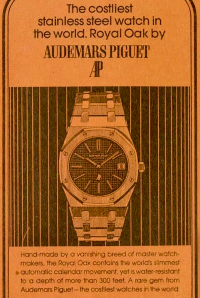
Italy responded first. Milan saw modernity where others saw provocation. Steel began to feel intentional rather than inferior. Over time, the watch shifted from anomaly to archetype. There was no dramatic reversal and no quiet withdrawal. Audemars Piguet let the watch find its audience.
Through the late 1970s and into the 1980s, variations followed. Complications entered the octagonal frame. A smaller Royal Oak II appeared to suit narrower wrists, widening the watch’s reach without softening its character. What once looked radical grew familiar, then canonical.
The Royal Oak did not rescue the company in a single season. It altered its trajectory gradually, until the old center of gravity disappeared.
In Le Brassus, snow still falls the way it did in 1972. Workshops still glow before dawn. Hands still finish bridges under magnification. If you hold an early 5402ST today, you are not holding inevitability. You are holding the moment a small company chose exposure over comfort.
It is not difficult to imagine the Royal Oak as a footnote. The Royal Oak was a wager against irrelevance, and for more than fifty years, it has held. Yet every icon faces the same test: whether it can remain daring after it becomes safe. In 1972, the Royal Oak was uncertainty cast in steel. Today, it is certainty.
And, time has a way of testing certainty.
- The Escapement